- Focus on local visibility first. Most self-storage customers rent within a 3 to 5-mile radius, making local SEO and Google Business Profile your most valuable marketing channels.
- Build trust to drive conversions. Strong reviews, quality photos, transparent pricing, and an easy online rental process help turn prospects into tenants.
- Use a balanced marketing mix. Combine local SEO, referrals, reputation management, and targeted ads to maximize occupancy and revenue.
- Avoid common marketing gaps. Regularly optimize your listings, website, reviews, and campaigns to stay competitive and improve ROI.
- Support growth with the right insurance strategy. Purpose-built insurance solutions help protect your facility, strengthen tenant confidence, and support long-term business growth.
Self-storage is a need-based business, not a desire-driven one.
Tenants don’t want to rent a 10×10 unit the way they might want a new pair of shoes or a weekend getaway. They rent because they’re moving, downsizing, renovating, or running out of room for inventory.
And this distinction matters enormously for self-storage marketing, because the job isn’t to create demand out of thin air. It’s to be the most visible, most trustworthy, and easiest option the moment that demand appears.
That’s also why location does so much of the heavy lifting in this industry. According to data, approx 80% of self-storage customers rent within a three- to five-mile radius of the facility they choose, which means self-storage marketing succeeds or fails almost entirely on hyper-local visibility rather than broad brand awareness.
Most renters find a facility through one of three channels: local search, drive-by visibility, or a referral from someone they trust. A smart self-storage marketing plan is built around those three channels first, not around whatever tactic looks impressive in a case study.
This blog explores strategies that help self-storage operators increase occupancy, optimize pricing, improve tenant retention, and drive sustainable revenue growth.
What Are Self-Storage Customers Looking For?
Unlike many industries, self-storage marketing isn’t about creating demand. It’s about being visible when demand already exists. Understanding how renters actually shop helps operators invest in the channels that matter most, rather than spreading budgets across tactics that rarely influence leasing decisions.
3 Common Ways Most Renters Find a Facility
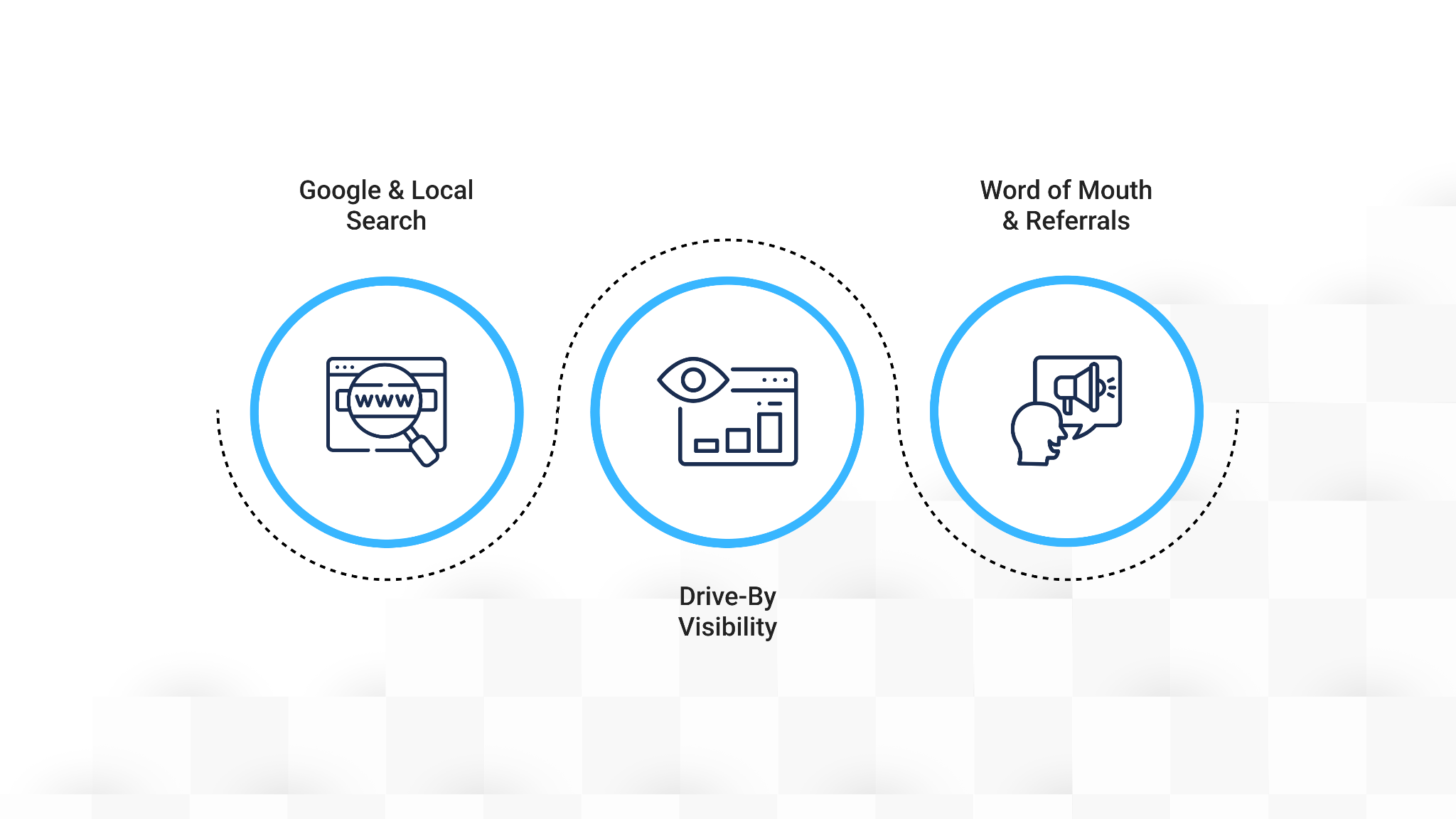
Most self-storage customers discover facilities through one of three channels.
1. Google & Local Search
For many facilities, Google is the starting point.
Searches like:
- “Self storage near me”
- “Climate-controlled storage in [city]”
- “Vehicle storage near me”
typically come from people who need storage immediately rather than casually researching options.
Because approximately 80% of customers rent within a 3 to 5-mile radius, appearing prominently in local search results often matters more than ranking nationally for broad industry keywords. Facilities that invest in local SEO and maintain a complete Google Business Profile consistently capture more high-intent traffic.
2. Drive-By Visibility
Not every customer begins their search online. Many renters notice a storage facility while commuting, moving through a neighborhood, or visiting nearby businesses. A clean property, clear signage, and a well-maintained entrance often create enough familiarity that when storage becomes necessary, your facility is already top of mind.
For facilities located on busy roads, physical visibility functions as a marketing channel in its own right.
3. Word of Mouth & Referrals
Recommendations continue to influence self-storage decisions. Satisfied tenants, real estate agents, apartment managers, moving companies, contractors, and local businesses frequently recommend facilities they trust.
These referrals often produce highly qualified renters because the recommendation already establishes credibility before the prospect ever visits your website.
Why the Buying Cycle Is So Short
Unlike products that involve weeks of research, storage rentals are usually driven by immediate needs.
Common triggers include:
- Moving to a new home
- Downsizing
- Home renovations
- College move-ins and move-outs
- Divorce or other life transitions
- Business inventory overflow
- Temporary relocations
In many cases, renters need a solution within days, sometimes even the same day. That urgency changes how self-storage marketing should be approached. Educational content and brand awareness still have value, but operators must prioritize visibility, accessibility, and a frictionless rental experience because prospects are often ready to make a decision immediately.
Customers Compare Fewer Facilities Than You Think
Many operators assume prospects evaluate numerous competitors before choosing a facility. In reality, most renters compare only one or two facilities before making a decision.
Once they find a location that:
- is close to them,
- fits their budget,
- appears clean and secure,
- has available units,
- and offers an easy reservation process,
They’re likely to stop searching. This means every additional barrier, whether it’s unclear pricing, outdated photos, poor reviews, or a complicated rental process, increases the likelihood of losing the customer to the next nearby option.
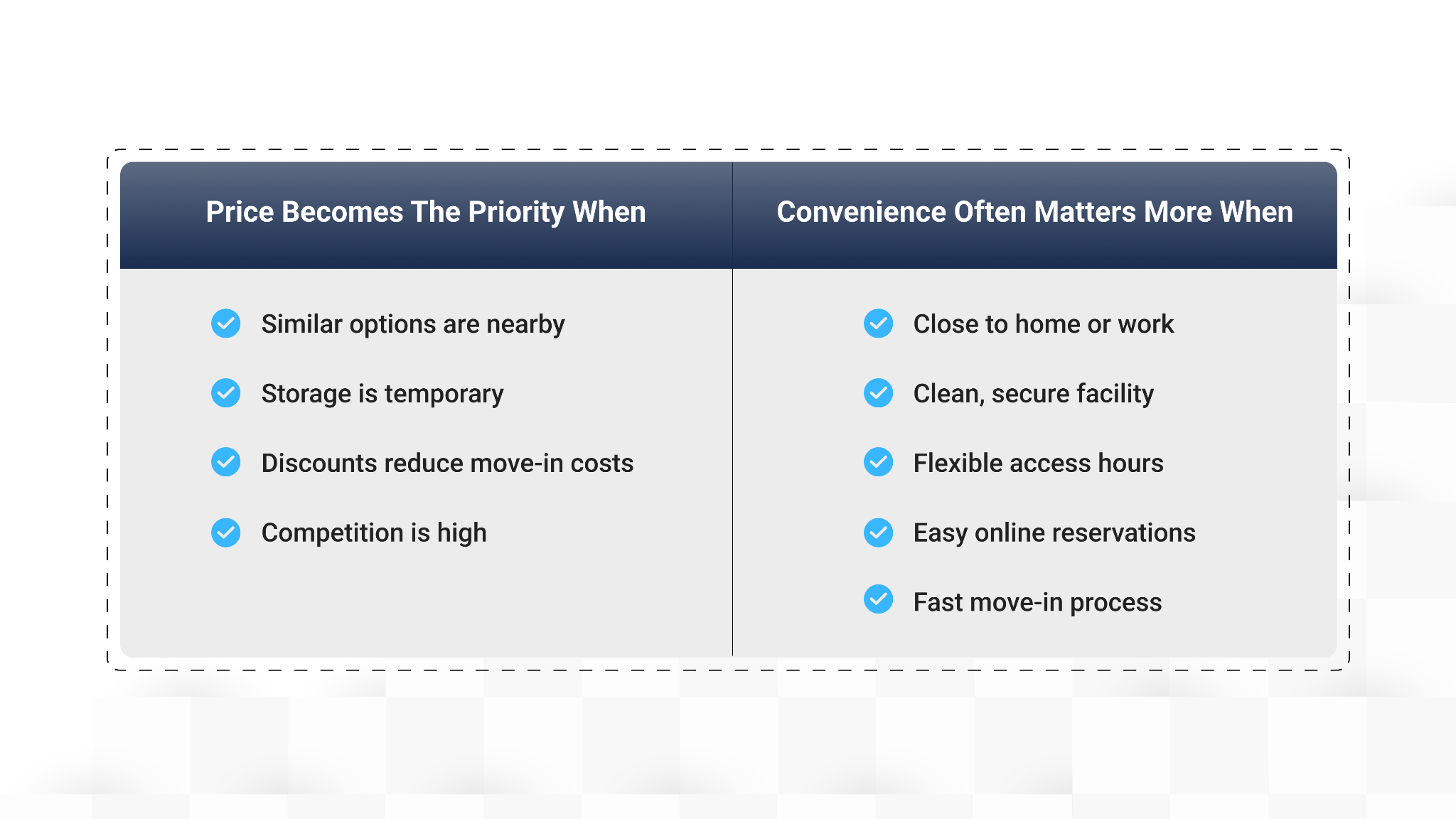
Price vs. Convenience: What Makes the Cut?
Price certainly influences purchasing decisions, but it’s rarely the only deciding factor. It’s worth noting that unit preferences reflect this nuance: the standard 10×10-foot unit commands over 35% of industry revenue, making it the most commonly rented size, but premium climate-controlled units are growing at the fastest rate, which signals that a meaningful segment of renters is willing to pay more for the right product.
Price sensitivity and willingness to pay are not uniform across your unit mix.
| Marketing Takeaway
Customer behavior should shape your marketing strategy, not the other way around. Rather than investing heavily in whichever marketing channel seems easiest to launch, prioritize the channels that match how renters actually search and decide: |
- Be visible where demand begins through Google and local search.
- Make your facility easy to notice through strong signage and curb appeal.
- Build trust through referrals, reviews, and customer experiences.
- Remove friction from every step of the rental journey.
The strongest self-storage marketing strategies don’t try to create demand. They simply make it easier for renters to choose your facility when demand already exists.
7 Strategies to Promote Self-Storage Marketing for Occupancy & Revenue
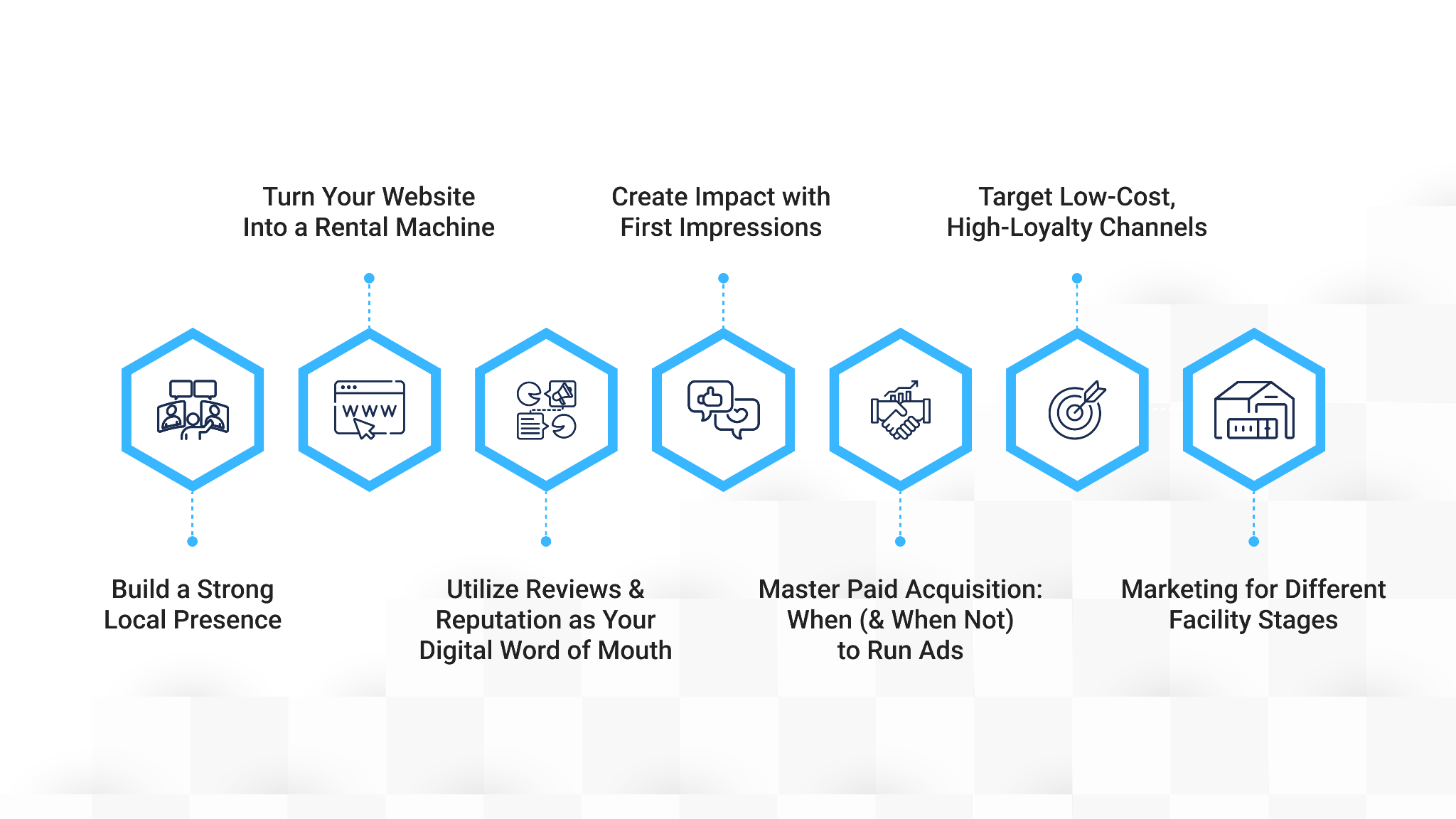
A strong self-storage marketing strategy starts with the fundamentals. These seven proven strategies help you attract more local renters, improve conversions, and drive sustainable occupancy growth.
1. Build a Strong Local Presence
For most facilities, self-storage marketing begins with local visibility. The national per-capita storage in the U.S. provides roughly 6.32 square feet of storage space per person, which means in most markets, your competitors are closer than they appear, and renters have options within a short drive.
When renters search for “self-storage near me” or “climate-controlled storage in [City],” they’re typically ready to rent, making local search one of the highest-intent marketing channels available to any operator.
Optimize Your Google Business Profile
Your Google Business Profile (GBP) is often the first interaction renters have with your business. Keep it complete and up to date with:
- High-quality property photos
- Accurate business and gate hours
- Phone number, website, and address
- Unit types and amenities
- Q&A section
- Regular posts and updates
- Recent customer reviews
An outdated or incomplete profile can cost you valuable rentals.
Maintain Consistent Business Listings
Ensure your Name, Address, and Phone Number (NAP) are identical across every listing, including:
- Google Business Profile
- Yelp
- Bing Places
- Apple Maps
- Facebook Business
- Storage-specific and local directories
Consistent listings improve both local SEO and customer trust.
Target Local Search Intent
Self-storage is a hyper-local business. Instead of broad keywords, optimize for searches like:
- Self-storage in [City]
- Climate-controlled storage in [Neighborhood]
- Storage units near [Landmark]
- Storage near me
These location-based searches typically have the strongest purchase intent.
Strengthen Your Local SEO
Support your Google Business Profile with a website that’s optimized for local search. Focus on:
- Location-specific title tags and meta descriptions
- Dedicated city or neighborhood pages (for multi-location operators)
- Clearly displayed address, phone number, and hours
- Embedded Google Maps
- References to nearby landmarks and communities
The easier it is for search engines and renters to understand where you’re located, the easier it becomes for them to find your facility.
Don’t Treat Local Listings as “Set and Forget”
One of the biggest mistakes in self-storage marketing is assuming local listings only need to be created once.
They require ongoing attention. Create a monthly maintenance checklist:
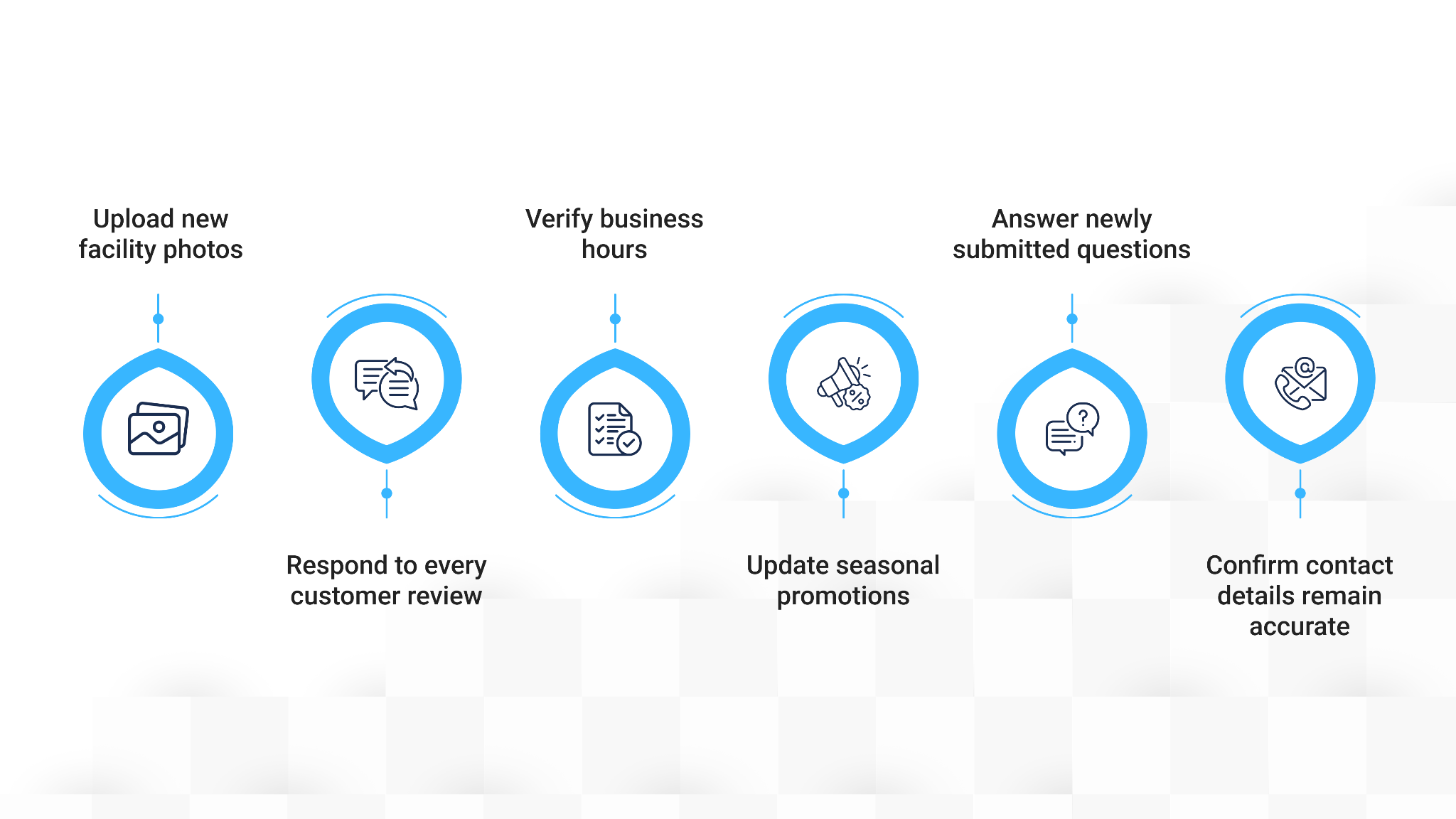
Google rewards businesses that keep their profiles active and up to date, while prospects naturally trust listings that appear well-maintained.
Local Visibility Checklist
Before investing in additional advertising, make sure you’ve completed these essentials:
| Area | What to Check |
|---|---|
| Google Business Profile | Complete profile, photos, services, reviews, Q&A, posts |
| Business Listings | Consistent NAP across all directories |
| Website SEO | Location-specific pages, title tags, contact details |
| Facility Information | Accurate hours, phone number, directions, amenities |
| Reviews | Ongoing review, generation, and timely responses |
2. Turn Your Website Into a Rental Machine
The best self-storage marketing strategies recognize that a website should accomplish three things exceptionally well: build trust, educate prospects, and convert them into tenants.
Here’s how you can achieve that in 5 easy steps.
Build Trust Before Asking for the Rental
Renters trust you with their valuable belongings. Before they compare prices, they’re evaluating whether your facility feels safe, professional, and reliable.
Your website should immediately answer that question.
Build trust with:
- High-quality photos of the actual property
- Customer reviews and testimonials
- Security features (gated access, surveillance cameras, individual unit alarms, lighting, etc.)
- A clean, modern website design
- Staff photos or contact information (when applicable)
- Professional branding and consistent messaging
Avoid relying on stock photos or generic storage images. Prospects want to see the actual facility they’ll be renting from.
Educate Customers Before They Call
Many rental inquiries aren’t about availability; they’re about uncertainty. Prospects simply want answers before committing. A well-designed website reduces friction by answering common questions upfront.
Include information such as:
@@PH0@@
Help customers understand which unit fits their needs.
Examples:
- Studio apartment
- One-bedroom home
- Business inventory
- Vehicle storage
Visual size guides and comparison graphics can significantly improve decision-making.
Adopt the Art of Transparent Pricing
Whenever possible, display:
- Starting prices
- Available promotions
- Monthly rental costs
- Climate-controlled vs. standard pricing
Hidden pricing often increases abandonment because customers assume they’ll need to call just to receive basic information.
Moreover, you’re asked to answer the following questions.
Frequently Asked Questions
Answer questions like:
- How does move-in work?
- What identification is required?
- Can I rent online?
- What are the gate access hours?
- Do you sell locks?
- Is tenant insurance required?
- How does billing work?
Every answered question removes another barrier to renting.
Make Renting Effortless
Even a great-looking website fails if the rental process is complicated. Today’s renters expect to reserve or rent a unit online in minutes.
Your website should include:
- Online reservations or online rentals
- Real-time unit availability
- Simple reservation forms
- Clear pricing
- Prominent phone number
- Live chat (if available)
- Strong calls-to-action throughout the site
Examples of effective CTAs include:
- Reserve Your Unit
- Rent Online
- Check Availability
- Get Directions
- Call Now
The fewer clicks between discovery and payment, the better your conversion rate.
Don’t Overlook Mobile Experience
Most local searches happen on mobile devices. If your mobile experience is slow or difficult to navigate, prospective tenants may never reach your reservation page.
Your mobile website should offer:
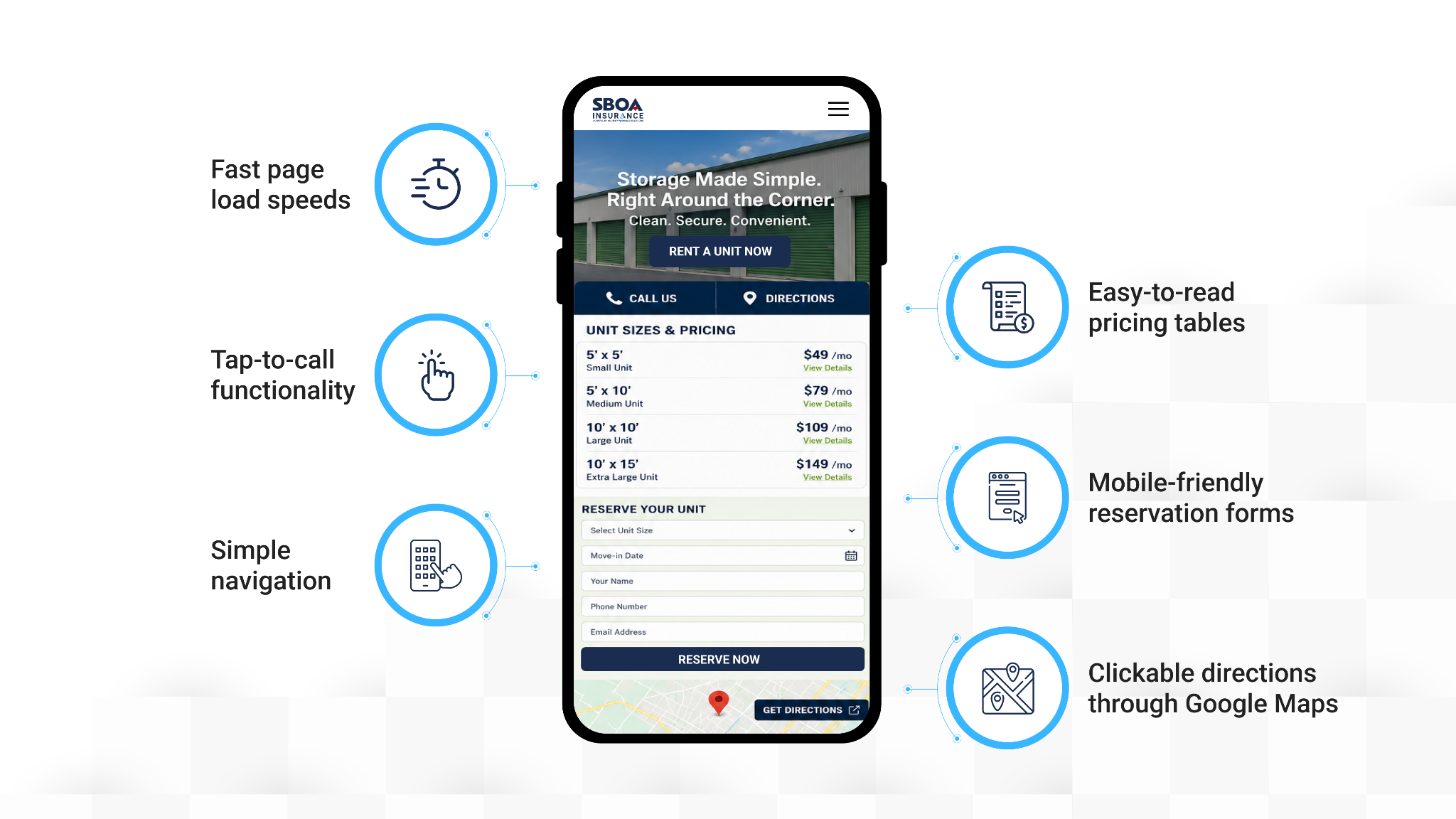
- Fast page load speeds
- Easy-to-read pricing tables
- Tap-to-call functionality
- Mobile-friendly reservation forms
- Simple navigation
- Clickable directions through Google Maps
Every second of loading time and every unnecessary form field increases the chance that renters abandon your site for a competitor.
3. Utilize Reviews & Reputation as Your Digital Word of Mouth
For most facilities, reviews are the modern version of word of mouth. They don’t just influence whether renters choose your facility; they also impact how easily they find it.
Strong reviews support self-storage marketing in two ways:
- Improve local search visibility: Google uses reviews as one of its local ranking signals, helping facilities appear more prominently in the Local Map Pack.
- Increase customer confidence: Positive reviews reassure prospects that your facility is clean, secure, professionally managed, and easy to work with.
Build a Consistent Review Generation Process
Many happy customers simply aren’t asked for feedback. Make review requests part of your standard customer journey by using:
- Post-move-in emails
- SMS follow-ups
- Front desk reminders
- QR codes at the office
- Direct review links in customer communications
The easier the process, the more reviews you’ll receive.
Respond to Every Review
How you respond matters just as much as the review itself.
| For Positive Reviews | For Negative Reviews |
|---|---|
|
|
Remember, your response is often read by future customers, not just the person who left the review.
Look Beyond Star Ratings
A high rating is important, but prospects also evaluate:
- Review volume: Do enough people recommend your facility?
- Recency: Are reviews being posted consistently?
- Consistency: Do customers repeatedly mention cleanliness, security, and customer service?
A facility with frequent, authentic reviews often inspires more confidence than one with a perfect rating based on only a handful of older reviews.
| Worth Noting: Never buy reviews or offer incentives for positive feedback. Instead, focus on delivering a great customer experience and making it easy for satisfied tenants to share it. Authentic reviews build long-term trust, while fake reviews can damage both your reputation and local search performance. |
4. Create Impact with First Impressions
Before a prospective renter compares prices or speaks to your team, they’ve already formed an opinion about your facility.
Whether they discover you through Google, your website, or while driving by, those first impressions influence whether they choose to rent. That’s why self-storage marketing extends beyond digital channels. Your property’s appearance is part of your marketing strategy.
Prioritize the Basics
Most renters aren’t looking for luxury amenities. They’re looking for confidence that their belongings will be stored in a facility that’s:
- Clean and well-maintained
- Safe and secure
- Easy to access
- Professionally managed
A tidy, well-lit property often builds more trust than expensive upgrades that don’t improve the customer experience.
Small Improvements Can Make a Big Impact
You don’t need a major renovation to improve first impressions. Focus on the details that renters notice immediately. Start with:
- Fresh paint where needed
- Clean landscaping and weed control
- Visible, well-maintained signage
- Functional gates and access systems
- Bright exterior and interior lighting
- Clean drive aisles, entrances, and office areas
These improvements reinforce that your facility is actively managed and well cared for.
Show Your Facility, Not Stock Images
Your photos should answer one question: “Can I trust this facility with my belongings?”
Include high-quality images of:
- Unit interiors
- Hallways and drive aisles
- Security features and gate access
- Office and reception area
- Exterior views showing cleanliness and accessibility
- Climate-controlled buildings, where applicable
Avoid:
- Generic stock imagery
- Outdated photos
- Blurry or low-resolution images
- Poor lighting
- Photos that don’t accurately reflect the property
Add Video to Boost Your Listing
Short walkthrough videos can help renters understand the facility before visiting.
Highlight:
- Property entrance
- Unit types and sizes
- Security features
- Drive-up access
- Office and rental process
Adding videos to both your website and Google Business Profile helps reduce uncertainty and improve engagement.
Treat Signage as a Marketing Asset
Your signage markets your facility every day, whether someone is actively searching or simply driving by.
Effective signage should be:
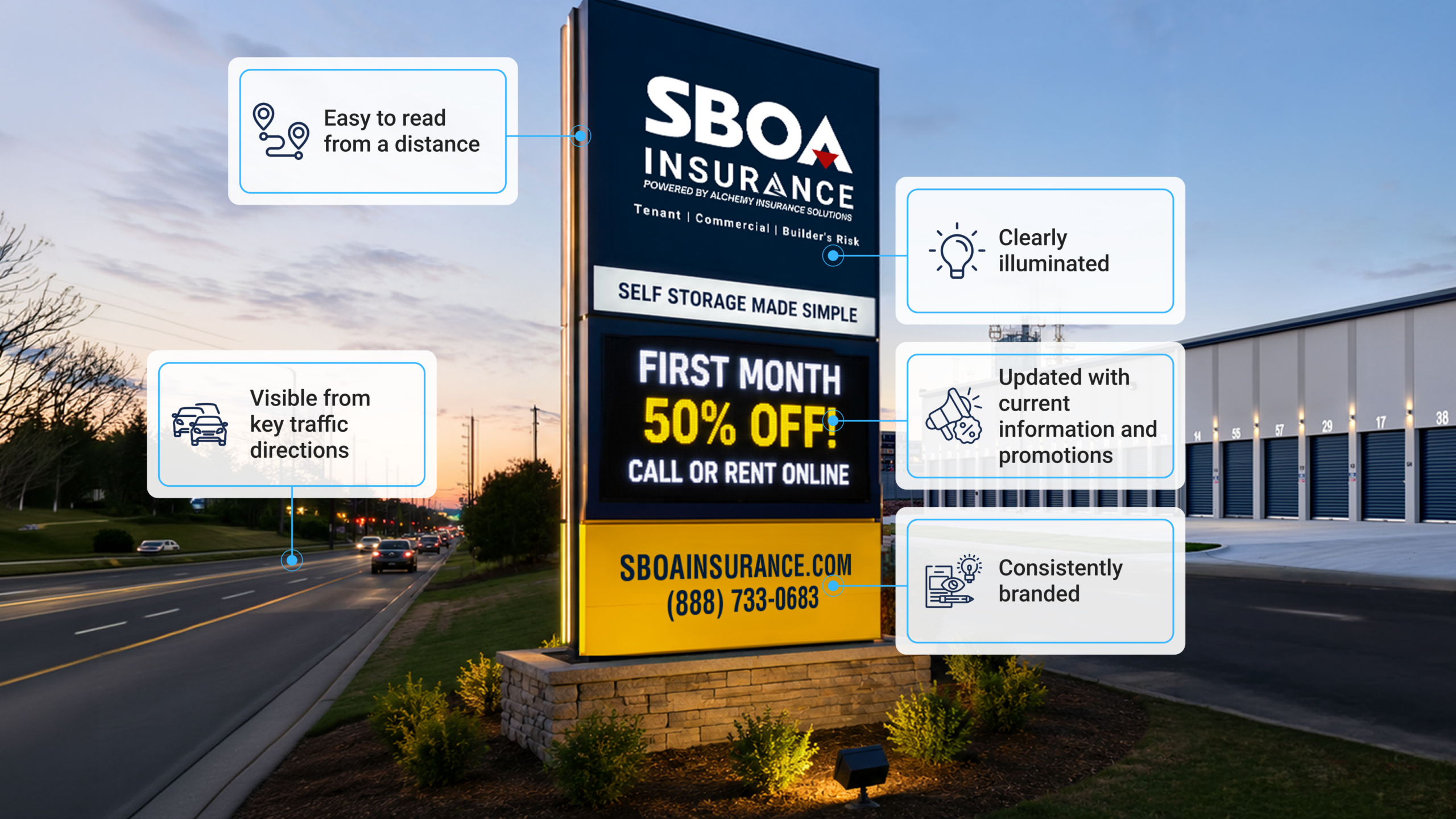
- Easy to read from a distance
- Clearly illuminated
- Consistently branded
- Visible from key traffic directions
- Updated with current information and promotions
Strong signage improves visibility today and builds awareness among future renters.
5. Master Paid Acquisition: When (& When Not) to Run Ads
Paid advertising should amplify a strong marketing foundation, not replace it. Before increasing ad spend, ensure your Google Business Profile, website, reviews, and customer experience are already converting visitors.
Prioritize High-Intent Channels
Focus your budget where renters are actively searching.
Google Search Ads
Target high-intent keywords such as:
- Self-storage near me
- Storage units in [City]
- Climate-controlled storage
- Vehicle storage
Traditional Local Advertising
Where relevant, reinforce your digital presence with:
- Billboards
- Direct mail
- Local newspapers or magazines
- Community sponsorships
- Local radio
Fix the Funnel Before Scaling
Don’t spend more until these basics are working:
- Google Business Profile is fully optimized
- Website converts visitors into renters
- Online reservations are available
- Reviews build trust
More traffic won’t solve the poor conversion.
Match Spend to Occupancy
| Lease-Up (0–50%) | Stabilized (85%+) |
|---|---|
| Google Search Ads | Branded search campaigns |
| Storage marketplaces | Remarketing campaigns |
| Grand opening offers | Seasonal promotions |
| Local awareness campaigns | Premium unit promotion |
Measure the Right Metrics
Track performance beyond clicks.
- Cost Per Lead (CPL): Cost to generate an inquiry.
- Cost Per Rental (CPR): Cost to acquire a paying tenant.
CPR provides a much clearer picture of marketing ROI.
Track Every Marketing Dollar
Your tracking stack should include:
- Call tracking
- UTM parameters
- Google Analytics
- Channel attribution
- CRM or property management reporting
6. Target Low-Cost, High-Loyalty Channels
Not every occupancy gain requires a larger budget. Some of the highest-performing self-storage marketing channels rely on trust, relationships, and customer advocacy rather than paid advertising.
Build a Referral Engine
Referral programs often deliver lower acquisition costs than paid campaigns.
Consider offering:
- Rent credits
- Free month’s rent
- Gift cards
- Referral bonuses
- Future rent discounts
Develop Local Partnerships
Build referral relationships with businesses that regularly interact with people needing storage.
Target partners such as:
- Realtors
- Moving companies
- Property managers
- Apartment complexes
- Home renovation contractors
- Senior living communities
Stay Active in Your Community
Increase local visibility through:
- Community events
- Chamber of Commerce activities
- Charity sponsorships
- School and sports sponsorships
Use Social Media to Build Trust
Social media supports credibility more than direct lead generation. Share:
- Facility updates
- Customer testimonials
- Security features
- Seasonal storage tips
- Community involvement
Follow Up With Interested Prospects
Simple email or SMS campaigns can recover prospects who didn’t rent immediately.
Examples include:
- Reservation reminders
- Promotional offers
- Availability updates
- Moving tips
- Abandoned reservation follow-ups
7. Marketing for Different Facility Stages
When planning across facility stages, it helps to keep the broader market trajectory in mind. With national occupancy rates near 90% and the market expected to reach $57.79 billion by 2031, the stabilized stage is not a signal to reduce marketing investment; it’s the stage where protecting the rate and optimizing revenue per occupied square foot become the primary objectives.
Business rentals, the fastest-growing segment in the industry, are particularly worth targeting at the growth and stabilization stages, as they tend to rent larger units, stay longer, and are less price-sensitive than personal renters.
Lease-Up (0–50%)
Goal: Build awareness and generate move-ins.
Prioritize:
- Google Business Profile
- Local listings
- Google Search Ads
- Storage marketplaces
- Grand opening offers
- Local awareness campaigns
Growth (50–85%)
Goal: Improve conversion and marketing efficiency.
Focus on:
- Local SEO
- Customer reviews
- Website improvements
- Online reservation flow
- Referral programs
- Optimized paid campaigns
Stabilized (85%+)
Goal: Protect occupancy and maximize revenue.
Invest in:
- Reputation management
- Google Business Profile maintenance
- Retention initiatives
- Dynamic pricing
- Premium unit promotion
- Selective paid advertising
Plan Around Seasonal Demand
Adjust campaigns around recurring demand drivers:
- Spring and summer moving season
- College move-ins and move-outs
- Home renovations and downsizing
- Business inventory fluctuations
Plan promotions before demand peaks rather than reacting afterward.
Align Marketing With Revenue
Marketing and pricing should support the same objective.
Focus on:
- Promotions based on occupancy
- Visibility for slower-moving unit types
- Protecting pricing where demand is strong
- Measuring revenue, not just lead volume
6 Common Marketing Gaps That Impact Occupancy
Even facilities with healthy marketing budgets can struggle if they’re investing in the wrong areas. More marketing isn’t always the answer. Better priorities are.
| Mistake | Better Approach |
|---|---|
| 1. Advertising outside your trade area | Focus on renters within your 3 to 5-mile service radius using local keywords and geo-targeted campaigns. |
| 2. Trying to outspend national brands | Compete on local SEO, reviews, customer experience, and convenience instead of ad budget. |
| 3. Driving traffic to a weak website or GBP | Optimize your website, Google Business Profile, pricing, and online rental flow before increasing ad spend. |
| 4. Ignoring reviews and listing hygiene | Keep photos, business hours, reviews, and listings accurate and up to date. |
| 5. Not tracking marketing performance | Measure Cost Per Rental (CPR), conversion rates, phone calls, and channel attribution, not just leads. |
| 6. Treating marketing as a one-time project | Regularly update your website, listings, reviews, photos, and campaigns to stay competitive. |
The strongest self-storage marketing strategies aren’t built on bigger budgets. They’re built on consistently improving the channels that have the greatest impact on occupancy and revenue.
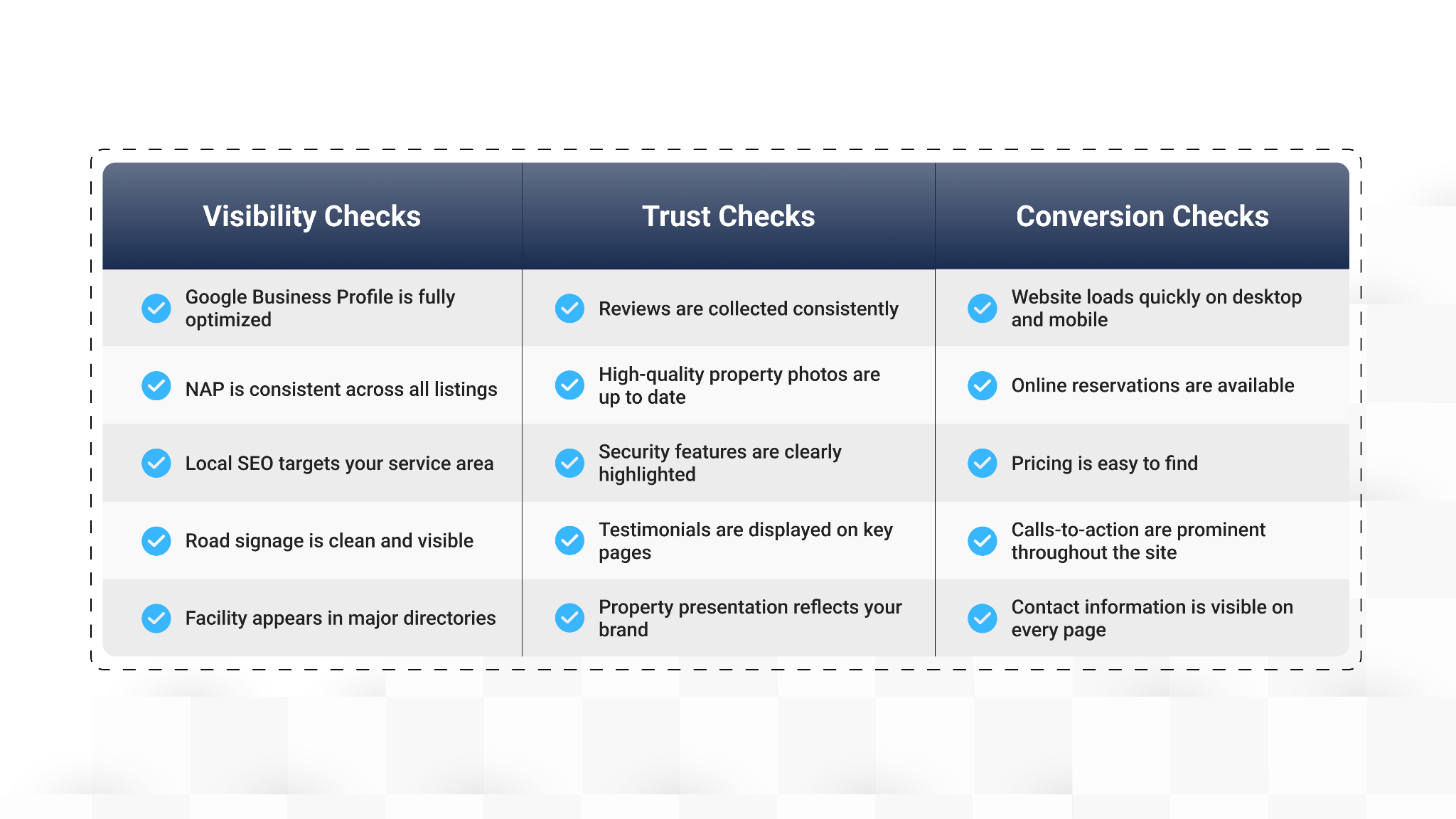
Self-Storage Marketing Checklist
Use this checklist to evaluate where your marketing stands today.
At its core, self-storage marketing is about removing friction between “I need storage” and “I rented here.”
The operators that consistently grow occupancy don’t rely on a single channel or marketing campaign. They built a system that makes it easy for local renters to find their facility, trust their business, and complete a reservation with minimal effort.
The priority order is straightforward:
- Get found locally through Google Business Profile, local SEO, and accurate business listings.
- Build trust quickly with strong reviews, professional photos, and a well-maintained facility.
- Make renting easy through a fast, mobile-friendly website with clear pricing and a simple reservation process.
- Layer on paid acquisition only after these fundamentals are performing well.
If you’re looking to improve occupancy, start by auditing the marketing assets that influence every rental decision:
- Google Business Profile
- Customer reviews
- Website and online rental flow
- Property photos and curb appeal
Small, consistent improvements across these areas often deliver far greater returns than simply increasing your advertising budget.
Strengthen Your Self-Storage Business With SBOA Insurance
Growing occupancy is only part of the equation. The right tenant insurance program can also create an additional recurring revenue stream while giving your tenants valuable protection. With SBOA Insurance’s Fortified Tenant Insurance Program, self-storage operators can strengthen their risk strategy, simplify program administration, and generate additional income, all through a solution purpose-built for the self-storage industry. Whether you’re looking to enhance your current tenant insurance offering or introduce a revenue-generating protection program, our team can help you evaluate the right approach for your facility.